Insurance & ALE coverage
Insurance-Paid RV Housing on Your Property: How ALE Coverage Works
Agile RV Housing delivers fully equipped RVs to homeowner properties across the lower 48 states, usually within a week and 48 hours in most areas, and bills the insurance carrier directly under Additional Living Expense coverage.
What ALE / Loss of Use coverage pays for
Nearly all standard homeowners policies include Additional Living Expense coverage. It is also called Loss of Use, or Coverage D on your declarations page. It pays the extra costs of living elsewhere while your home is uninhabitable from a covered loss.
Lodging is the core expense. ALE exists so your family has somewhere to sleep that is not your damaged home, and the carrier pays for it while repairs are underway. Meals above your normal grocery spend, additional mileage, and storage can also fall under ALE, but lodging is almost always the largest line item on the claim.
An on-site RV qualifies as lodging. It is a self-contained dwelling with a kitchen, bathroom, and sleeping quarters, and it satisfies the same need a hotel room or short-term rental would. It also typically costs the carrier far less than months in a hotel: a family of four in two hotel rooms for five months runs well past what an RV placement costs over the same period. That cost difference is the main reason adjusters approve on-property RV housing once it is presented properly.
For a deeper walkthrough of caps, limits, and what surprises homeowners mid-claim, read our practitioner's guide to what ALE insurance actually covers.
Wind and hail are covered. Flood usually is not.
This distinction decides more claims than any other, and most homeowners learn it too late.
Standard homeowners policies cover wind, hail, fire, and fallen-tree damage. ALE applies to all of them. If a windstorm tears off your roof, if hail destroys your siding, if a tree comes through your living room, or if a fire makes the house unsafe, your policy is designed to respond and Loss of Use coverage is designed to house you while it is repaired.
Flood damage is different. It is excluded from standard homeowners policies. Rising water, storm surge, and overland flooding are covered only by a separate flood insurance policy: either through the National Flood Insurance Program or a private flood carrier. Those policies handle additional living expenses differently, and NFIP policies in particular provide very limited or no ALE benefit. For the detail, see the flood coverage gap explained.
Here is the practical takeaway. A single storm often causes both kinds of damage at once. If a hurricane or severe storm hit your home, the wind damage and tree damage are very likely covered by your homeowners policy even when the flooding is not. Those are two separate claims against two separate policies, and they are adjusted separately.
So ask your adjuster specifically about your wind claim and whether ALE is available under it. Do not accept a blanket "this was a flood" answer for a house that also lost its roof. We have this conversation with homeowners and adjusters every week, and we can help you frame the question. See also our guide on why adjusters hesitate about RV housing and when they're right.
How direct billing works, step by step
Six steps from first call to pickup. Most homeowners pay nothing out of pocket along the way.
-
1
You or your adjuster contacts Agile RV Housing
Call the 24/7 housing line at (614) 655-4286. Adjusters, housing coordinators, and homeowners all use the same number.
-
2
We confirm ALE / Loss of Use coverage with your carrier
We verify the claim is active and that Additional Living Expense coverage can be applied to an on-property RV before anything is scheduled.
-
3
We match a floorplan to your household size
Units range from compact couples' layouts to large family floorplans with bunk rooms. We walk you through photos and dimensions.
-
4
We deliver, level, and connect the RV on your property
Usually within a week, and 48 hours is achievable in most areas. Delivery, leveling, and power, water, and sewer hookup coordination are all handled by us.
-
5
We invoice the carrier directly on a monthly basis
Homeowners are not fronting the housing cost. Your specific policy terms (limits and deductibles) are confirmed with your adjuster before placement.
-
6
When repairs finish, we pick the unit up
We tow the RV out and restore the site. No cleanup, no disposal, nothing left for you to arrange.
Why stay on your own property
You oversee the rebuild daily. Contractors work faster and cut fewer corners when the homeowner walks the site every morning. Questions get answered in minutes instead of days.
Your kids stay in their schools. No district transfer, no new bus route, no explaining to a seven-year-old why everything changed at once. The address on file does not change.
Your pets stay with you. Hotels and short-term rentals restrict pets by size, breed, and count, and boarding a dog for five months is both expensive and hard on the animal. An RV on your own lot has no pet policy to negotiate.
You keep a security presence on the property. A damaged, empty house with a tarp on the roof attracts theft and vandalism, and materials staged for the rebuild disappear from unattended sites. Someone being home matters.
You avoid repeated hotel moves. Long claims frequently outlast a hotel's extended-stay block, and families get relocated two or three times mid-repair. You unpack once in an RV and stay put.
If you are still weighing the alternatives, we wrote an honest comparison of hotels, apartments, rentals, and on-property RVs.
What's included in every unit
Every unit has a full kitchen and a full bathroom. Refrigerator, range, oven, microwave, sink, shower, and toilet: the unit functions as a house, not as a campsite.
Floorplans are sized for couples through large families. Compact layouts suit two people; larger units carry separate bedrooms and bunk rooms that sleep six to eight. We match the floorplan to your household during intake.
A linens and housewares kit comes with the unit, so you are not buying plates and towels the week after a fire. A washer and dryer are available: important on a five-month stay with kids.
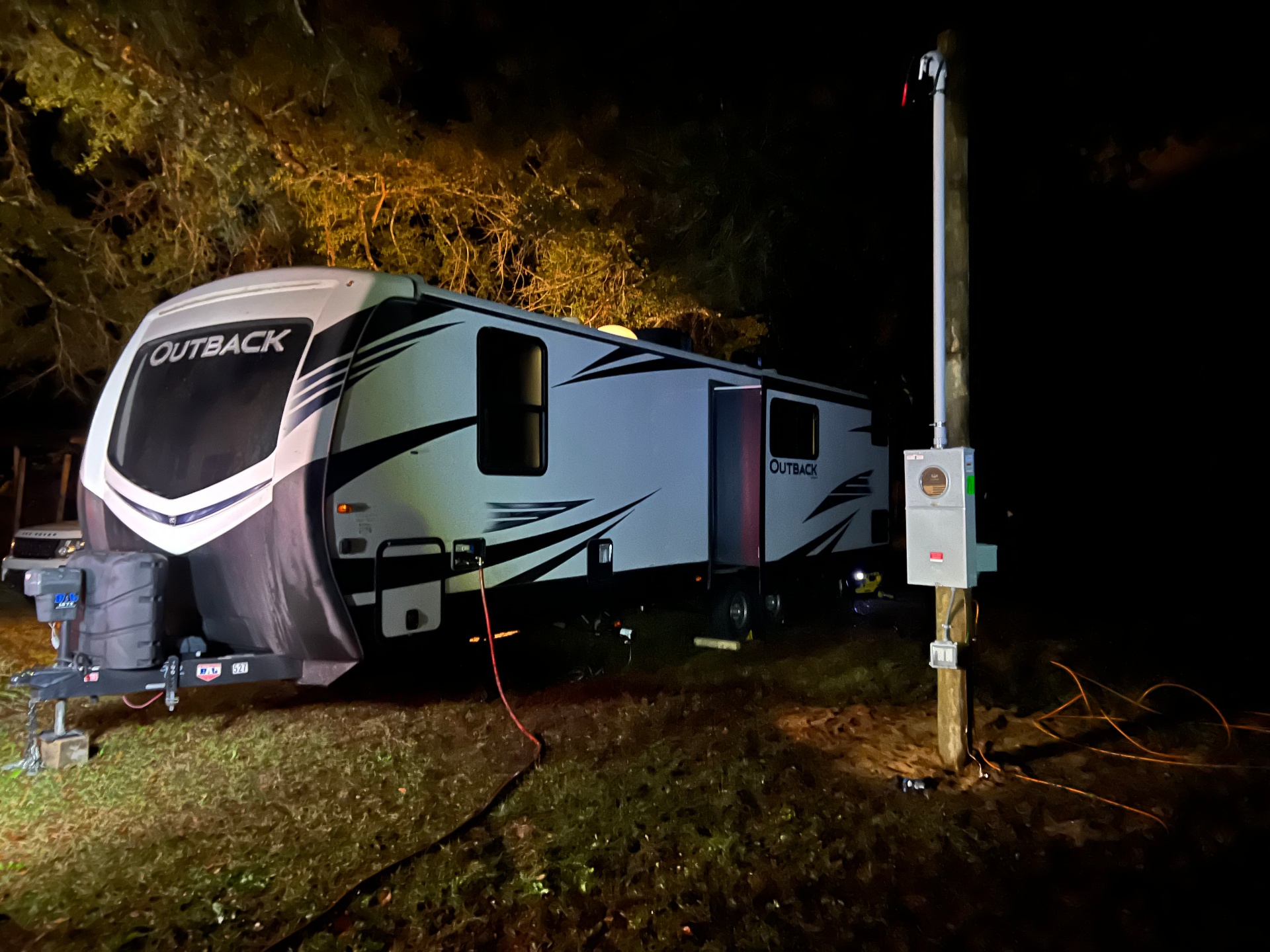
We coordinate utilities for power, water, and sewer connections. That includes bringing in a licensed electrician when your property needs a dedicated hookup. See exactly what that involves on our RV utility setup page covering power, water, and sewer.
Rentals start at a 60-day minimum and stay as long as covered repairs continue. A typical placement runs about five months.
Frequently asked questions
Does homeowners insurance pay for an RV on my property?
Yes, under Additional Living Expense (ALE) coverage, when the loss is covered. Nearly all standard homeowners policies include ALE (also called Loss of Use or Coverage D) which pays the extra costs of living elsewhere while your home is uninhabitable. Lodging is the core expense ALE covers, and an RV placed on your own property qualifies as lodging. It typically costs the carrier far less than months of hotel stays, which is why adjusters approve it.
How fast can the RV arrive?
Usually within a week from approval, and in most areas we can be there in 48 hours. Agile RV Housing serves homeowners across the lower 48 states, and delivery, leveling, and utility hookup coordination all happen in that window. Electrical service is usually the gating factor, so we start coordinating it in parallel with delivery.
Do I pay anything up front?
In most covered claims, no. We invoice your insurance carrier directly on a monthly basis under ALE coverage, so you are not fronting the housing cost. We confirm coverage with your carrier before delivery, and your specific policy terms (limits and deductibles) are reviewed with your adjuster before placement.
My home flooded: am I covered?
It depends on whether the damage was caused by wind or by flood. Standard homeowners policies cover wind, hail, fire, and fallen-tree damage, and ALE applies to all of them. Flood damage is excluded from standard homeowners policies and is covered only by separate flood insurance through NFIP or a private carrier, which handles additional living expenses differently. If a hurricane or storm damaged your home, the wind and tree damage is very likely covered even when the flooding is not. Ask your adjuster specifically about your wind claim and ALE. We can help you ask the right questions.
How long can I keep the RV?
Rentals start at a 60-day minimum and stay as long as covered repairs continue. A typical placement runs about five months. There is no maximum term: the unit stays until your home is livable again.
Talk to the 24/7 housing line
We confirm ALE coverage with your carrier before anything is scheduled. Adjusters and homeowners use the same number.